How to Import Flexible Packaging from China: A Step-by-Step Buyer’s Guide
More food, snack, and consumer brands are sourcing flexible packaging,from China — and for good reason. Chinese manufacturers offer 9-color gravure printing, food-grade materials, and unit costs that are hard to match elsewhere. But for first-time importers, the process can feel overwhelming.
As a flexible packaging manufacturer with six years of export experience serving Southeast Asia, Latin America, and beyond, we walk you through every step so your first order runs smoothly.
Step 1: Choose the Right Pouch Style
Before contacting any supplier, know what bag type your product needs:
Snacks, nuts, coffee → Stand-up pouches or Eight side seal pouches
Liquids, sauces, honey → Spout pouches
Ready meals, wet pet food → Retort pouches
Single-serve sachets, spice packs → 3 side seal flat pouches
Automatic FFS filling lines → Roll film
Not sure which fits your product? Read our snack packaging guide for a product-by-product breakdown.
Step 2: Verify the Supplier
Not every factory on Alibaba is equal. Before sending an inquiry, check:
- Certifications — ISO 9001 (quality), ISO 22000 (food safety), FSSC 22000 (international food safety system), and national production licenses
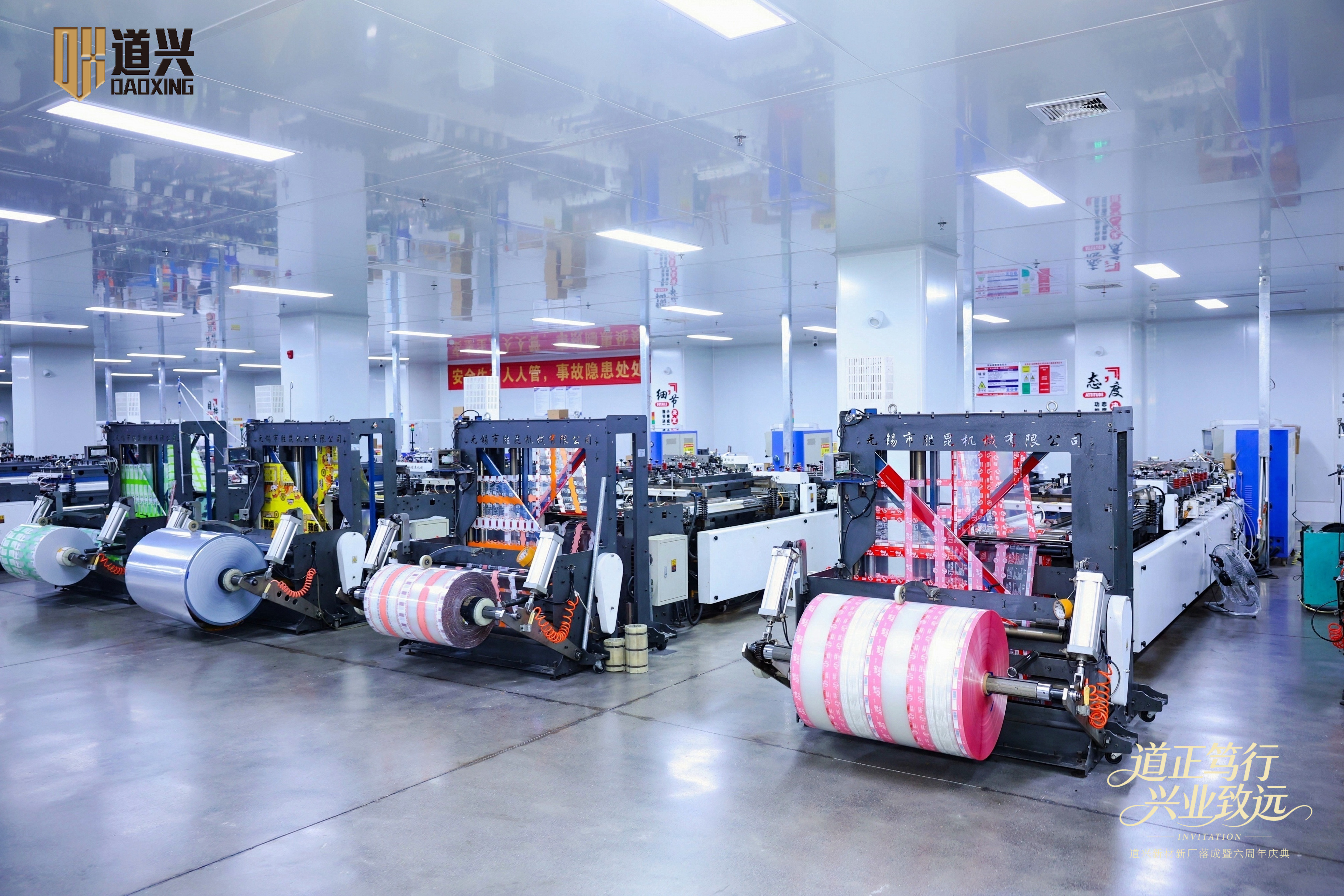
- Factory scale — a 30,000 m² workshop with automated lines means stable capacity and consistent quality
- Export track record — ask which countries they export to and request references
- Production workflow — understanding how bags are made helps you evaluate quality. Our production workflow guide explains every step from lamination to finished pouch
For a detailed verification checklist, read our guide on how to verify a food-grade supplier
Step 3: Request Samples
Before committing to a bulk order, always request samples:
- Blank samples — check material quality, seal strength, and printing surface. Usually free, you pay shipping
- Printed samples — confirm color accuracy, registration, and finish (matte/glossy). There may be a small sample fee
- Test with your product — fill the sample bag, seal it, and run it through your filling line to confirm compatibility
Step 4: Approve Artwork & Printing
Once you confirm the bag specification:
- Send your artwork files (AI or PDF vector format preferred)
- The factory provides a digital proof for your approval
- Check colors (CMYK/Pantone), text, barcode readability, and legal compliance for your target market
- Approve the proof — production starts after your written confirmation
We support up to 9-color gravure printing with full CMYK color matching.
Step 5: Understand MOQ & Lead Time
| Item | MOQ | Lead Time |
|---|---|---|
| Custom printed bags | USD 5,000 minimum order value | 15–20 days for bulk orders, trial orders faster |
| Roll film | USD 5,000 minimum order value | 12–18 working days |
| Blank bags | Small trial orders OK | 5–8 working days |
.png)
Step 6: Arrange Payment & Shipping
Payment terms commonly used for China packaging exports:
- T/T (Telegraphic Transfer) — most common. 30% deposit before production, 70% before shipment
- L/C (Letter of Credit) — for larger orders, provides buyer protection
- Western Union / PayPal — for small sample orders
Shipping methods:
- Sea freight (FCL/LCL) — most cost-effective for bulk orders. 15–35 days depending on destination
- Air freight — faster but more expensive. Good for urgent small batches
- Express (DHL/FedEx) — only for samples
Trade terms:
- FOB — you arrange shipping from the Chinese port. Most common
- CIF — supplier arranges shipping to your port. Easier for first-time importers
- DDP — supplier handles everything to your door. Simplest but slightly higher cost
Step 7: Handle Customs & Documentation
Your supplier should provide these documents:
- Commercial Invoice — product description, value, HS code
- Packing List — quantity, weight, dimensions
- Bill of Lading (B/L) — shipping document for sea freight
- Certificate of Origin — may reduce import duties under trade agreements
- Material Safety Test Report — proves food-grade compliance
Check your country’s import regulations for flexible packaging. Some markets (EU, US, Australia) require specific food-contact testing standards.
Get Started
Importing flexible packaging from China does not have to be complicated. With the right supplier and a clear process, you can save 30–50% compared to local sourcing while maintaining quality.
Documents You Should Expect From Your Supplier
Smooth customs clearance depends on paperwork that matches the goods. For a typical flexible packaging shipment you should receive a commercial invoice, a packing list and a bill of lading, and — for food-contact products — material test reports and food safety documentation for the laminate structure. Ask for these before placing the order, not after the goods ship: a factory that produces export documentation routinely will send samples of each document without hesitation, and that habit is a reliable signal of how the whole project will run.
Three First-Order Mistakes That Cost the Most Time
First, approving artwork as a low-resolution image or without checking panel sizes against the die drawing — every later correction multiplies. Second, underestimating first-order tooling time: new printing cylinders and sample approval are one-time steps that disappear on repeat orders, but they need to be planned into a launch date from day one. Third, skipping the filling test — even a perfectly made pouch can need a small adjustment in seal temperature on a specific machine, and it is far cheaper to discover that on a sample bag than on 50,000 delivered units. Plan for those three points and a first import usually runs as smoothly as the reorders that follow.
Contact us today — send us your product type, bag size, material preference, and order quantity. We will reply with a quotation and sample plan within 24 hours.